Imagine running an organisation with hundreds of sites, thousands of employees and a PPE policy that looks watertight on paper. You’ve got approved suppliers, certified products and a clear purchasing procedure.
That must mean everything's covered, right?
But what happens when things don't go quite to plan? What happens when someone on site can't get the equipment they need? Or when an approved product isn't quite right for the job? Would a team start ordering something else?
If these things are happening, then that policy doesn't look quite so watertight.
I was reading a report in Health & Safety Matters this week* which highlighted that 276 out of 315 high-risk PPE products tested by the Office for Product Safety and Standards were non-compliant. Nearly nine in ten.
It’s a shocking figure, but it got me thinking about a bigger question. We're very good at checking whether PPE meets the right standards. But how good are we at checking whether the systems behind it are actually working?
Compliance is essential, but PPE compliance alone isn't proof of PPE control.
PPE compliance is about making sure protective equipment meets the relevant standards and requirements, whereas PPE control takes things a step further. PPE control is about knowing whether the right equipment is reaching the right people, and whether purchasing processes are working as intended. It also means knowing whether problems are being picked up and resolved.
When you're managing PPE across hundreds of locations, that's easier said than done!
Here’s a quick scenario. A utility company with teams working across the country has one site that needs replacement equipment urgently, but the approved product isn't available. Someone finds an alternative, places an order and gets the team what they need.
Problem solved?
Possibly, but even if the alternative was perfectly suitable, did anyone actually check? Does it meet the agreed specification? And does anyone responsible for PPE procurement centrally even know it's being purchased?
It's a good example of how an organisation can have the right procedures in place without necessarily knowing what's happening across its operations.
If you want to gain more control over PPE, my advice would be not to rely on policies and purchasing reports alone. I'd suggest starting with three questions that tell us much more about how well your PPE programme is working.

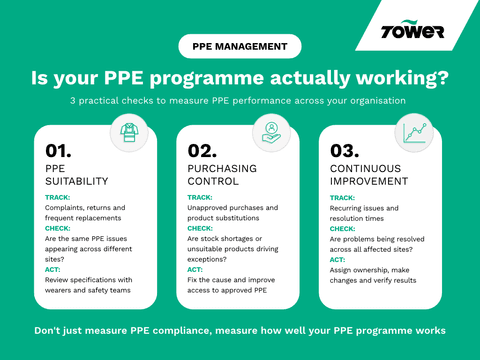
This is a key starting point that I recommend working with your supplier on thoroughly and regularly. It’s important because you can spend months getting a PPE specification agreed, but the real test comes when someone puts that equipment on and starts work. That’s the point at which you need to be asking:
If people are regularly requesting alternatives, returning products or replacing equipment sooner than expected, then it can be an early sign that the PPE is not right for the job.
I would start looking at wearer complaints, product returns and replacement frequency across different sites. If the same product keeps causing problems, it might be time to revisit the specification.
And rather than making that decision in isolation, involve the people actually using the equipment. They're often best placed to explain where something isn't working.
After all, there is no point in having a compliant product if it isn't suitable for the job!
Imagine a site manager trying to get replacement PPE for someone starting a shift. The approved product is out of stock, and getting an alternative authorised could take longer than they can reasonably wait. What would you expect them to do? They need PPE.
Tightening the purchasing rules won't necessarily solve the problem that led to someone looking elsewhere. It’s more important to understand what's driving those decisions and situations in the first place. Find out whether:
Tracking purchases outside the approved range and looking for patterns across locations can help identify where the real problems sit. And once you understand the cause, you can do something about it. Good PPE management should make doing the right thing straightforward, not leave people looking for ways around the system.
This is where organisations need to be honest with themselves about how they are dealing with issues.
For instance, if several sites are raising concerns about the same product, then it’s likely that complaints are recorded, purchasing data is reviewed, and everyone agrees something needs to change. But if six months later the same complaints are still coming in, what has actually been achieved?
There's no shortage of information available to organisations managing large PPE programmes. The challenge is turning that information into action.
I'd focus on three things:
Identifying a problem is only half the job. The real value comes from being able to show that you've solved it!
None of this makes PPE compliance any less important. But for organisations protecting thousands of people across power networks, utilities, transport and facilities management, I think we should be setting our sights higher.
Approved products, established suppliers and clear purchasing procedures are essential, but the real test is how well they work across different sites, teams and operational environments.
That requires safety, procurement and operational teams to share what they know, listen to the people using the equipment and work together to address problems rather than simply report them.
It's also why I believe the role of a PPE supplier should go well beyond delivering products. Large, complex organisations need experienced consultative PPE partners who understand their operational challenges, aren't afraid to question established processes, and have the people and skills to help their customers improve how PPE is managed across the entire business.
If you take one thing away, remember that it's not enough to know that your PPE meets the right standards. You need to know that the whole system works for the people depending on it. This will make the difference between compliance and genuine control.
Fill out a contact form to book a PPE review with one of our experts.

Bruce works at the forefront of global requirements and is a leading authority on arc flash PPE. Bruce is also highly knowledgeable about the requirements of the Energy and Utilities industry.