If you have ever worked on a cruise ship, you will know that the smallest things can cause big problems. ‘Toilet not flushing’ (TNF) for example, is often caused by something as simple as using the wrong tissue. But it’s a situation that can turn a regular calm morning into a chaotic rush to solve the issue quickly to ensure it doesn’t result in dissatisfied guests!
The symptoms of TNF are there to see. A blocked cabin here, a slow flush there, and suddenly the team is juggling guest complaints and maintenance calls. It also seems to happen at the worst possible moment, so it’s always worth checking what toilet tissue you are using in your cabins and other areas.
The below experiment shows you the difference between fast and slow dissolving tissue, making it clear why we always recommend fast dissolving tissue to customers.
Unlike your plumbing at home, cruise ships have always depended on systems that are designed to move waste quickly and consistently. But that only works when the materials entering the system break down fast enough. If tissue takes too long to dissolve, it can linger and clump, which increases the chances of TNF.
Manufacturers measure dissolving speed using tests such as AFNOR Q34 020 (I will explain that later), which checks how quickly cellulose‑based tissue breaks apart in water. Anything that dissolves within two minutes passes the standard. On land, that’s fine, but on a ship with thousands of flushes a day, two minutes is far too slow.
In the video, I use three types of toilet paper, three containers of water, a timer, and a gentle stir. When you watch the three‑ply hold its shape, the standard two‑ply soften slowly, and the fast‑dissolving tissue begin to fall apart almost immediately, the difference becomes obvious. It’s the kind of demonstration I hope gets housekeeping teams nodding along because they’ve seen the consequences onboard.
By the way, if you want to see all the toilet tissues we provide from LuxySoft, you can look at the full range we supply to cruise lines by downloading our new paper catalogue.
If you look at the below graph, the horizontal axis shows disintegration time in seconds and the vertical axis is dissolving degree in percent. Each coloured line represents a different product type, from standard toilet tissue to extra‑fast‑dissolving hand towels.
See that orange line running through the middle? That is the AFNOR requirement, which means reaching full disintegration by that point and the product meets the standard.
Now look at the extra‑fast‑dissolving toilet tissue. Its line shoots up and hits 100 percent at around ten seconds. That’s not just a AFNOR pass, it’s finished dissolving long before the regulation limit is even close!
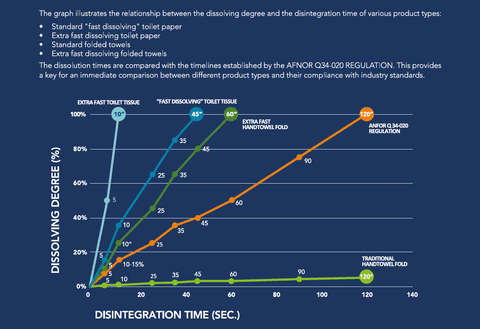
Standard fast‑dissolving tissue takes around forty‑five seconds. Extra‑fast‑dissolving folded hand towels take around sixty. Traditional folded towels barely dissolve at all, even after two minutes. You can almost picture what that means inside a system that depends on rapid breakdown of toilet tissue in water.
The message is clear. Tissue that dissolves quickly give the system less to fight against, and tissue that breaks down completely leaves fewer fragments that can catch on bends or fittings. And products that exceed the AFNOR standard by a wide margin give you more breathing room in real‑world conditions.
That can mean fewer TNF incidents, blocked cabins, and interruptions for your team. It’s not the only factor that can lead to incidents of course, but it’s one you can control.
Toilet paper isn’t a glamorous cruise necessity, but it’s one of those details that makes a noticeable difference to how smoothly a ship runs, which means we care about it.
If you work in hotel operations, housekeeping, or procurement then you likely have your own stories about TNF or subtle products that made a substantial difference. We’d genuinely like to hear them and if you want to talk through which dissolving tissues might be right for your vessels, the Tower Supplies team is always happy to help!